
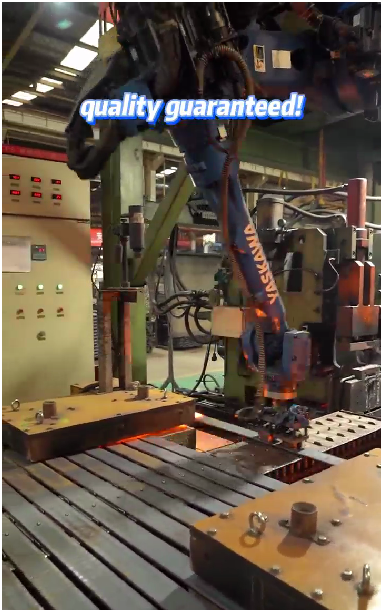
Hello everyone, we are CDXS Leaf Spring, a high-quality and high-performance leaf spring. From the initial raw material stage to the final product, it needs to go through more than ten meticulous manufacturing processes. These process links are interlinked, and each step will have a profound impact on the final performance and quality of the leaf spring. Therefore, the precise control of each process is particularly crucial.
1.Blanking process and punching
Using a blanking machine or a hydraulic shearing machine, the raw materials are precisely cut into blanks of specific specifications and sizes according to the product process diagram. This is the initial stage of leaf spring production, and its significance is self-evident.
2. Rolling process
After heating the leaf spring billet to an appropriate temperature, it is carefully rolled into full-length conical or parabolic leaf springs through a long cone rolling mill according to the stiffness requirements. At present, the long cone extension process has been modularized and occupies an important position in the production process of leaf springs. This process involves hot stamping of the rolling center hole, as well as multiple fine processing steps such as head cutting, ribbing and grooving, edge and corner cutting, bending and punching at the end of the leaf spring
3. Ear rolling process
After heating the leaf spring blank that meets the conditions for rolling the ear to a specific temperature, it goes through the processes of pressing and cutting the head, rolling the ear into shape, etc. in sequence, and is finally processed into a rolling ear sheet suitable for a single loading requirement.
4. Heat treatment: Heat the end of the steel plate, rapidly quench it to increase hardness, and then bend it into a hook shape or a specific form to facilitate assembly on the vehicle.
5. Forming processing: Use molds and presses to precisely bend the heat-treated steel plates to form specific curves of the springs and the ends of the fishing baits.
6. Tempering treatment: The formed springs are subjected to tempering treatment to eliminate internal stress and enhance elastic stability.
7. Surface treatment: The springs are treated for anti-corrosion through methods such as electroplating and painting. A common approach is to dip them in black paint to enhance durability.
8. Assembly inspection: Assemble each spring sheet into a complete assembly according to the designed sequence, and check the size, strength and fit accuracy of the springs.
9. Functional testing: Conduct load tests on the assembled leaf spring assemblies to ensure they meet the requirements for load-bearing and shock absorption performance.
10 Packaging and warehousing: Qualified products are packaged, marked with relevant information and then stored in the warehouse, ready to be sent to the automobile manufacturer or the aftermarket.