
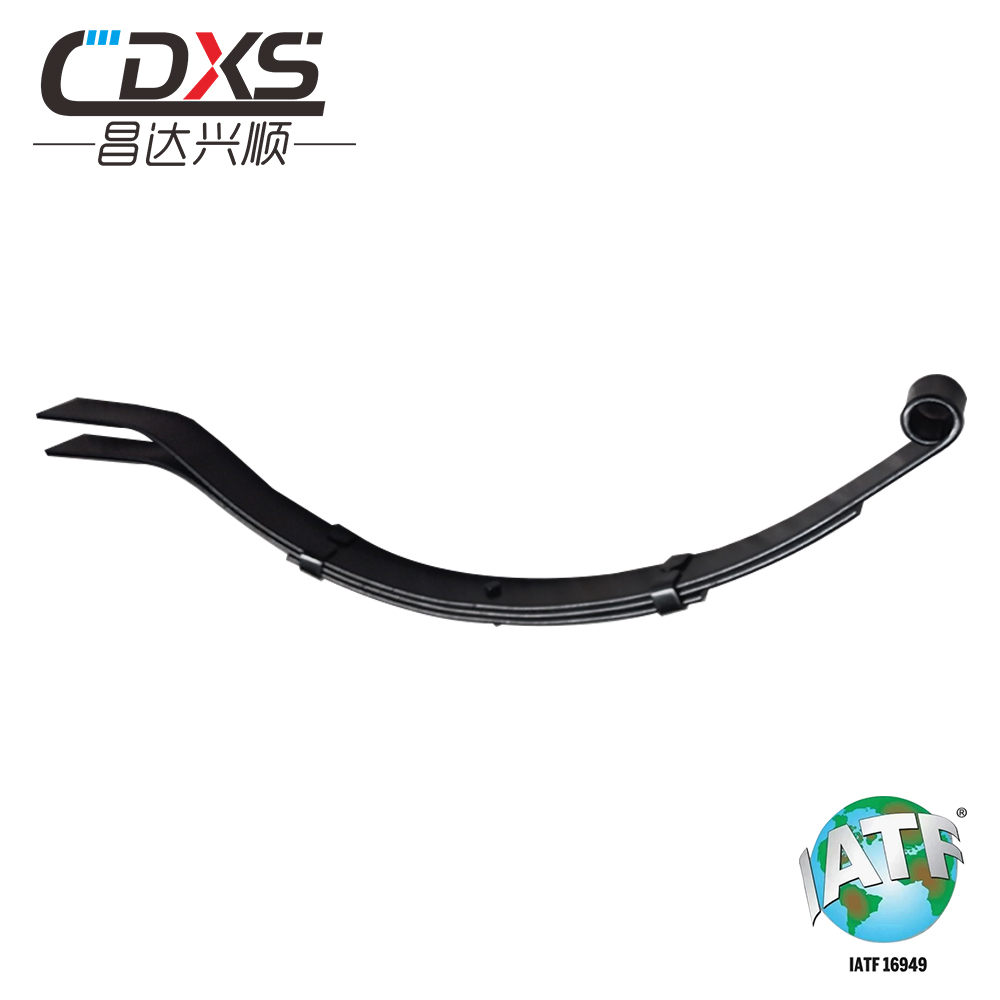
These terms are all mechanical performance indicators involved in the design of automotive leaf springs and the selection of raw materials. Its terms and differences are as follows:
1. Stiffness
Definition: The ability of a material or structure to resist elastic deformation.
The greater the stiffness, the smaller the deformation under the same external force.
It is related to the elastic modulus (E), but the elastic modulus is a material property, while stiffness is a structural property (such as the stiffness of a single leaf spring/assembly).
2. Strength
Definition: The ability of a material to resist permanent deformation or fracture.
Tensile strength: The maximum stress at which tensile failure can be resisted.
Compressive strength: The ability to resist compressive failure.
Yield strength: The critical stress at which a material begins to undergo plastic deformation.
3. Hardness
Definition: The ability of a material’s surface to resist local indentation or scratches.
Test methods: Brinell hardness HB, Rockwell hardness HRC.
The relationship with strength: Materials with high hardness usually have higher strength, but there is no strict correspondence.
4. Deflection
Definition: The elastic displacement produced by a structure under force (such as the deflection of a single leaf spring/assembly).
Large deflection indicates low stiffness.
The calculation formula is related to the type of leaf spring structure.5. Elasticity
Definition: The ability of a material to return to its original shape after the external force is removed.
Elastic limit: The maximum stress value at which a material maintains its elasticity.
6. Toughness
Definition: The ability of a material to absorb energy during plastic deformation and fracture.
The difference from strength: High-strength materials may be brittle and have low toughness. Materials with good toughness do not necessarily have high strength.
Test method: Impact test (such as Charpy impact test).
7. Rigidity
Rigidity: Emphasizing the overall characteristic of a material or structure that it is not prone to deformation (qualitative description).
Stiffness: It is a quantitative indicator of rigidity (such as N/m).
8. Plasticity
Definition: The ability of a material to maintain its new form after deformation beyond its elastic limit.
Plasticity is the opposite of brittleness. Brittle materials have almost no plasticity. Other differences:
Stiffness and strength: High stiffness does not necessarily mean high strength.
Hardness and toughness: High hardness but poor toughness, prone to cracking.
Elasticity and plasticity: Elastic deformation is reversible, while plastic deformation is irreversible.