
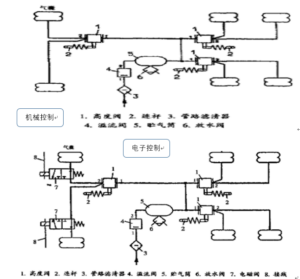
The principle of air suspension: By taking advantage of the elastic deformation of air springs and the compressibility of air, the traditional leaf springs are replaced by air springs in the form of suspension. It is composed of related components such as the air compressor of the engine, the air handling unit of the vehicle, the air tank of the braking system, the air springs of the suspension, and shock absorbers According to the difference in their control modes, they are divided into mechanical control mode and electronic control mode. The working principle is that when the vehicle is running, the engine drives the air compressor to work. The compressed air produced is processed by the air treatment unit (such as a drying tank, oil-water separator, etc.) to filter out moisture and impurities, and then stored in the vehicle’s air storage tank through the pressure regulating valve. Then, when it is necessary to inflate or deflate the vehicle’s air suspension airbags, the height control valve (mechanical mode) or the solenoid valve (electronic control mode) controls the valve to inflate or deflate the airbags, thereby adjusting the height of the airbags.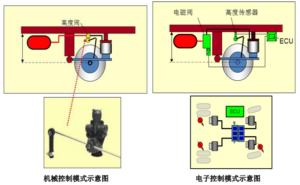
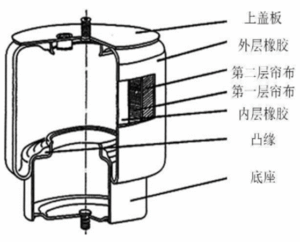
2. Main Components of Air Suspension 2.1 Air Spring Structure. An air spring refers to a spring that uses the elastic characteristics of closed air as an energy medium. It is composed of components such as a rubber airbag, a base, an upper cover plate, and a buffer pad. Among them, the most important rubber airbag is a composite formed by the combination of inner and outer rubber layers, fabric layers, and formed steel wire rings through vulcanization. The inner rubber layer, also known as the airtight rubber layer, is composed of oil-resistant and highly airtight rubber materials to form a sealed container. The advantage of this approach is that it can prevent air leakage. The outer rubber layer is the rubber layer that ensures the reliable performance of the airbag. The material of the outer rubber layer is resistant to ozone erosion and light radiation, and can play a role in sealing and protection. The curtain layer serves a load-bearing function and is also known as the skeleton layer. It usually consists of two layers, made of materials such as polyvinyl chloride, nylon, and rayon card that are resistant to pressure, flex, and have strong rubber adhesion. The curtain layer directly affects the fatigue strength of the air spring.
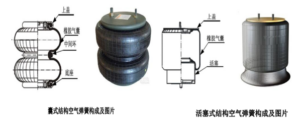
According to the structure of the airbag and whether it has a piston, the structural types of air springs are mainly divided into two categories: airbag type and piston type. The appearance is shown in the following figure. The bladder air spring acquires elasticity based on the deflection deformation of the rubber airbag. The bladder air spring has a large spring stiffness and is mostly used in trailers or trailer lifting axles. The more times the airbag bends, the smaller the stiffness of the air spring. However, if there are too many bends, it is easy to reduce the lateral stability of the spring. Generally, if there are more three bends, the load curve will be steeper and it is not suitable for use in multiple suspension driving heights. Or suspension systems that require load control have a longer service life compared to piston air springs. Piston-type airbags can be designed to store or not store air in the inner cavity of the piston according to the stiffness requirements, thus allowing for different states. The elastic characteristics are related to the shape of the piston. Pistons with different contour lines can be designed as needed to achieve better elastic properties. The spring stiffness is small, the number of metal parts is large, and the manufacturing cost is relatively high.
The service life of air springs can reach over 3 million times, while the service life of traditional leaf springs is usually only about 500,000 to 600,000 times. Compared with leaf springs, air springs have a higher fatigue life and a longer service time. In addition, for the same model of air spring, by adjusting the internal pressure value of the air spring, different load-bearing capacities can be obtained to meet the requirements of various load conditions. Meanwhile, the installation height of the air spring can be adjusted through the height regulating valve to meet the requirements of various structures. Therefore, the air spring has good economy and versatility. 2.2 Guiding mechanism.
1) Single longitudinal arm structure. The guide arm of the front suspension with a single longitudinal arm structure is relatively long, which is conducive to stabilizing the rearward Angle of the main pin, adding an automatic self-centering function, and improving the overall handling of the vehicle. The air suspension of this structure can not only reduce the center position of the vehicle’s longitudinal overturning moment but also enhance the vehicle’s own anti-longitudinal roll capability.
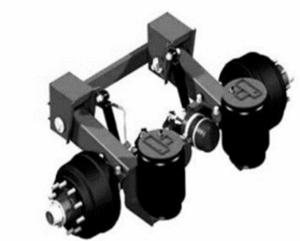
2) Leaf spring structure. The leaf spring structure, due to the addition of an air spring at one end of the leaf spring structure, not only retains some of the elastic characteristics of the leaf spring structure but also enhances the characteristics of the air spring.
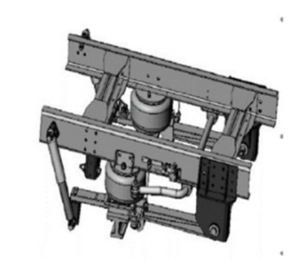
3) Double transverse arm structure. For the double wishbone structure, due to the reasonable arrangement of the upper and lower arm lengths, the entire vehicle has good stability. However, its structure is complex, and the force points are concentrated, resulting in weak load-bearing capacity.
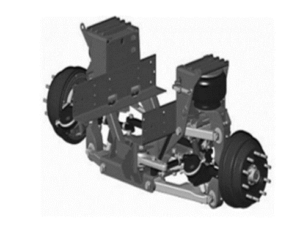
4) Double longitudinal arm structure. The two longitudinal thrust rods on the double longitudinal arm structure form a tripod structure. Through the tripod structure and the two longitudinal thrust rods below, a four-bar linkage mechanism is formed. This structure can transmit force both longitudinally and laterally.
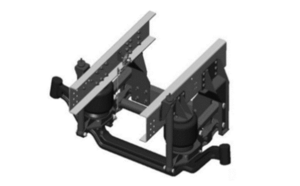
Based on the differences in design structures, air suspensions can be generally classified into three major categories: full airbag air suspensions, composite air suspensions, and floating bridge air suspensions. Floating bridge suspension is rarely used in the market. Currently, the mainstream air suspension heavy-duty trucks in the market are mainly full airbag air suspension and composite air suspension.
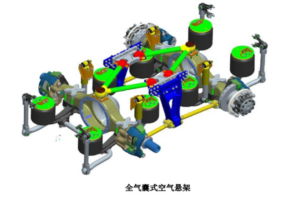
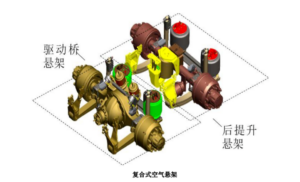
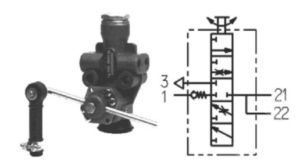
2.3 Height control valve. The principle of the height control valve is to control the height of the air spring by regulating the change of gas pressure inside the air spring. It is divided into two types: real-time type and delayed type. The type that can adjust the spring in a timely manner is called the real-time height valve. Its characteristics are timely control, which is conducive to improving the working condition. However, the installation and manufacturing precision are high. Because it is in a real-time working state, the load is large. It has increased the wear between components. A height control valve with a delay in control time is called a delayed type. The period varies, with the common ones being between 2 and 4 seconds, close to the vibration period. This enables a transition between components, effectively reducing the load, friction and noise of the response.
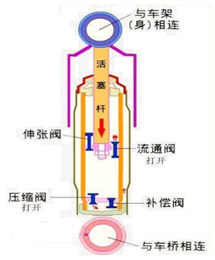
2.4 Shock Absorbers. The shock absorber structure is divided into upper and lower parts. The lower double-layer steel cylinder assembly is filled with oil and nitrogen (some do not have nitrogen). The pressure reducing valve is located at the bottom, and the piston is assembled in the hydraulic cylinder. The piston rod guide seat and the sealing ring are located at the top of the lower assembly and are connected to the upper part of the shock absorber. In addition, there is a lifting ring containing a rubber isolation bushing or isolation ring at the lower part of the steel cylinder.
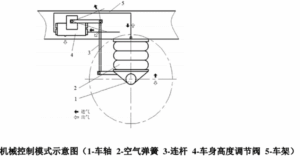
3. Control Modes and Characteristics of Air Suspension 3.1 Mechanical Control Mode. The basic principle of the mechanical control mode air suspension system is that when the static load on the vehicle increases, it will compress the air spring, causing the height of the air spring to decrease to a certain extent. Due to the reduction in the height of the air spring that supports the suspension, the height of the height valve connected to the vehicle body will also decrease. This will cause a significant rotation of the valve swing connecting the height valve and the spring. The horizontal position deviation of the swing will open the intake mechanism of the height valve, and the compressed air in the air storage tank will enter the air spring through the connecting pipeline. The “compressed” air will push the height adjustment lever back to its original horizontal position in the opposite direction. At the same time, the air spring also returned to its previous working state. On the contrary, when the static load on the vehicle decreases, the exhaust valve will be opened, and the air in the bag will be discharged into the atmosphere, gradually returning the vehicle body to the set height.
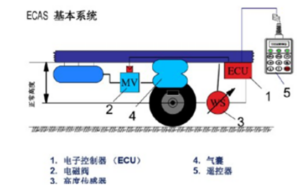
3.2 Electronic control mode. The Electronic controlair suspension system (ECAS for short) is composed of ECU, remote control, height sensor, solenoid valve, airbag, etc. The electronic control unit (ECU) receives the command input from the remote control. The height sensor detects the changes in the vehicle’s height and transmits the information to the ECU. The ECU judges the vehicle’s status based on speed, braking, pressure information, etc., and controls the action of the solenoid valve through certain control logic to inflate and deflate each airbag to adjust the vehicle’s height. When in operation, the height sensor is first responsible for detecting changes in the vehicle’s height and then transmitting the information to the ECU. Besides the height information, different measurement devices can also be equipped according to different needs to obtain other input information, such as vehicle speed information, air supply pressure and braking information, etc. After receiving the input information, the ECU analyzes and calculates the input information based on the control algorithm stored inside to obtain the output control signal, which controls the actuator of the air suspension (mainly the solenoid valve) to act accurately, and adjusts the stiffness of the air spring and the damping of the shock absorber in a timely manner to ensure the handling stability, ride comfort and road friendliness of the vehicle during driving.
4. Air Suspension Airway Process Scheme 4.1- Generally used in the air suspension systems of buses and trucks.
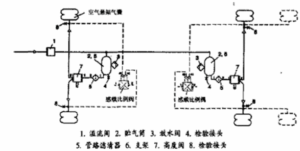
4.2 Air suspension pipeline diagrams for trailers and semi-trailers
Hengsaier Auto Parts Co., Ltd. is a manufacturer specializing in the production of leaf springs and air suspensions. If you have any needs, please contact me for the most favorable quotation
phone :+86 18837405116
Email:[email protected]