

This document covers the process parameters for normalizing, annealing, quenching and tempering of common carbon steels, alloy structural steels, tool‑and‑die steels and steel castings, specifications for heating and holding duration, as well as hardness values at different tempering temperatures.
Ⅰ. General Heat‑Treatment Process Routes
1.1 Process Routes
• For forgings: Forging → Annealing → Machining → Quenching (or surface quenching) → Tempering
• For section steels: Section steel → Machining → Quenching (or surface quenching) → Tempering
1.2 Heating and Holding Time
• Quenching heating: After reaching the quenching temperature, the holding time for temperature equalization is normally 0.8 min/mm. For alloy steels, it may be extended to 1.0‑1.5 min/mm.
• Tempering heating: After reaching the tempering temperature, the holding time for temperature equalization is normally 2 min/mm, to guarantee complete microstructure transformation in the core.
• Annealing / Normalizing: For carbon steels, 0.6 min/mm before through‑heating; hold for 1.5‑2 h once through‑heated. For alloy steels, 0.8 min/mm before through‑heating. For annealing, take workpieces out of the furnace only after furnace cooling to ≤ 350 °C.
Ⅱ. Quenching‑plus‑Tempering Process Parameters and Hardness Performance of Common Steel Grades
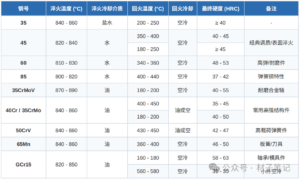
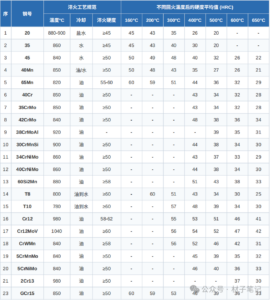
Ⅲ. Comparison Table of Different Tempering Temperatures and Hardness Values (HRC)
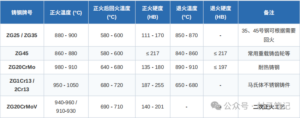
Ⅳ. Normalizing and Annealing Heat Treatment for Steel Castings
Ⅴ. Quenching‑and‑Tempering Heat Treatment for Large‑Sized Components (Based on Cross‑Section Dimensions)
For medium‑to‑large shafts and critical parts, the cross‑section effect must be taken into account during heat treatment. Below are reference hardness values (HB) of typical high‑strength steel grades after quenching‑and‑tempering (quenching + high‑temperature tempering) for different cross‑section sizes.
Note: For key components such as main shafts and rotors, vertical hanging quenching heating in a pit‑type furnace is mandatory to minimize distortion and ensure thorough heating of the core.
42CrMoA (Oil quenching at 840‑860 °C):
• Cross‑section ≤ 60 mm: Tempering at 550‑570 °C → 255‑321 HB
• Cross‑section 60‑100 mm: Tempering at 560‑580 °C → 248‑311 HB
• Cross‑section > 180 mm: Tempering at 590‑610 °C → 248‑277 HB
40CrNiMoA (Oil quenching at 840‑860 °C):
• Cross‑section ≤ 80 mm: Tempering at 520‑540 °C → 269‑341 HB
• Cross‑section 120‑240 mm: Tempering at 560‑590 °C → 241‑302 HB
20Cr1Mo1V1TiB / VnbTiB:
• Tempering temperature is generally controlled within 680‑720 °C; holding time shall be 6‑10 hours to stabilize the high‑temperature creep‑resistant microstructure.
We are a professional leaf spring manufacturer with 30‑years of industry experience. Please feel free to contact us for your requirements.
Anan +86 18837405116