

Introduction
Leaf springs are essential components in vehicle suspension systems, providing support, stability, and shock absorption. Producing a high-quality leaf spring requires careful material selection, precise manufacturing processes, and thorough quality control. This article outlines the key steps in manufacturing a durable and reliable leaf spring.
1. Material Selection
The quality of a leaf spring largely depends on the material used. High-carbon steel or alloy steel (such as 51CrV4 or 60Si2MnA) is commonly chosen due to its excellent strength, fatigue resistance, and flexibility. The steel must meet strict chemical composition standards to ensure optimal performance.
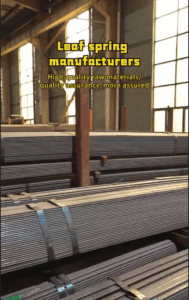
2. Cutting and Shearing
The selected steel is cut into strips of the required length and width using precision shearing machines. The edges must be smooth to prevent stress concentrations that could lead to cracks.
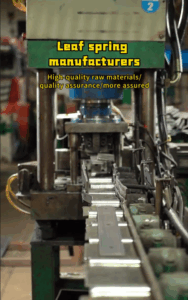
3. Heating and Forming
The steel strips are heated in a furnace to approximately 900–950°C to make them malleable. They are then fed into a forming press or rolling machine to achieve the desired curvature (camber). Proper heating ensures uniform deformation without internal stresses.
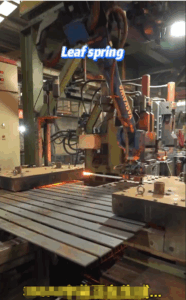
4. Quenching and Tempering
After forming, the leaf springs undergo heat treatment to enhance strength and durability:
– Quenching**: The heated spring is rapidly cooled in oil or water to harden the steel.
– Tempering**: The spring is reheated to a lower temperature (around 400–500°C) to reduce brittleness while maintaining toughness.

5. Shot Peening
Shot peening is a critical process where small metal beads are blasted onto the spring’s surface. This induces compressive stresses, improving fatigue resistance and extending the spring’s lifespan.

6. Assembly and Clamping
Multiple leaves are assembled into a pack, with the master leaf (longest one) at the top. The leaves are clamped together using a center bolt and reinforced with clips to prevent lateral movement.

7. Painting or Coating
To prevent rust and corrosion, the assembled leaf spring is coated with anti-corrosive paint or powder coating. Some manufacturers use epoxy coatings for enhanced durability.

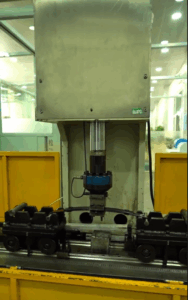
8. Quality Testing
Before delivery, each leaf spring undergoes rigorous testing, including:
– Load testing to verify deflection and stiffness.
– Fatigue testing to simulate long-term use.
– Hardness testing to ensure proper heat treatment.
Conclusion
Producing a high-quality leaf spring requires precision at every stage—from material selection to final testing. By following strict manufacturing standards and quality control measures, manufacturers can ensure reliable performance and longevity in demanding automotive applications.

Would you like additional details on any specific step? please contact me +86 18837405116