
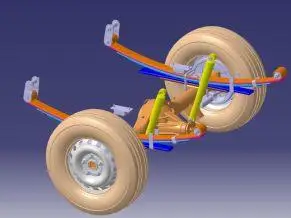
1.After a new vehicle has traveled 1,000 kilometers, the U-bolts of the leaf spring saddle should be tightened (maintaining the tightening torque value at the factory) to prevent the U-bolts from loosening, which may cause the leaf spring to shift, the vehicle to deviate, or the center hole of the leaf spring to break.
2. After the vehicle has traveled a certain mileage, the ear hole bushings and pins of the leaf spring should be inspected and lubricated in a timely manner. If the ear hole bushings are found to be severely worn, new bushings should be replaced in time to avoid noise at the ear hole connection parts. At the same time, to prevent the leaf springs from twisting and the vehicle from veering off course during driving due to uneven wear of the bushings.
3.When the vehicle has traveled a certain mileage and it is necessary to replace the leaf spring assembly, the leaf springs on both sides should be replaced simultaneously to prevent the vehicle from tilting due to inconsistent arc heights on both sides of the leaf springs and the possibility of overturning during rapid turns.
4. A fracture at the “center hole” of the assembly does not necessarily indicate a quality issue with the leaf spring. After the leaf spring is clamped by U-bolts, the strength at the “central hole” is greatly enhanced. Theoretically, it is considered a rigid whole, and the weak links should be the two ends of the “clamping plate” (where the stress is the greatest). We generally believe that it is caused by the U-bolt not being tightened in time. The fracture of a leaf spring from the end of the “clamping plate” to the middle of one end is a normal fracture, while the fracture from the “center hole” is an abnormal fracture.
5. When the assembly is in the loaded state and the arc height is reversed (i.e., the arc height is negative), it does not necessarily mean that the load-bearing capacity of the leaf spring is insufficient. When designing the entire vehicle, many leaf spring products are required to have a full-load arc height of zero or negative. When the product structure is fixed, the stiffness of the assembly will also be fixed. When the stiffness is fixed, the load-bearing capacity will also be fixed.
6. For composite springs or main and auxiliary spring structures, users can add pieces or thicken the assembly by themselves, which enhances the load-bearing capacity, but it may not achieve the desired effect (design calculation is required). After adding pieces or thickening the assembly, the rigidity or load-bearing capacity is enhanced, but the loading state is also changed. The load-bearing ratio of the main and auxiliary springs may have changed. In addition, increasing or decreasing the arc height is generally not conducive to use either.