
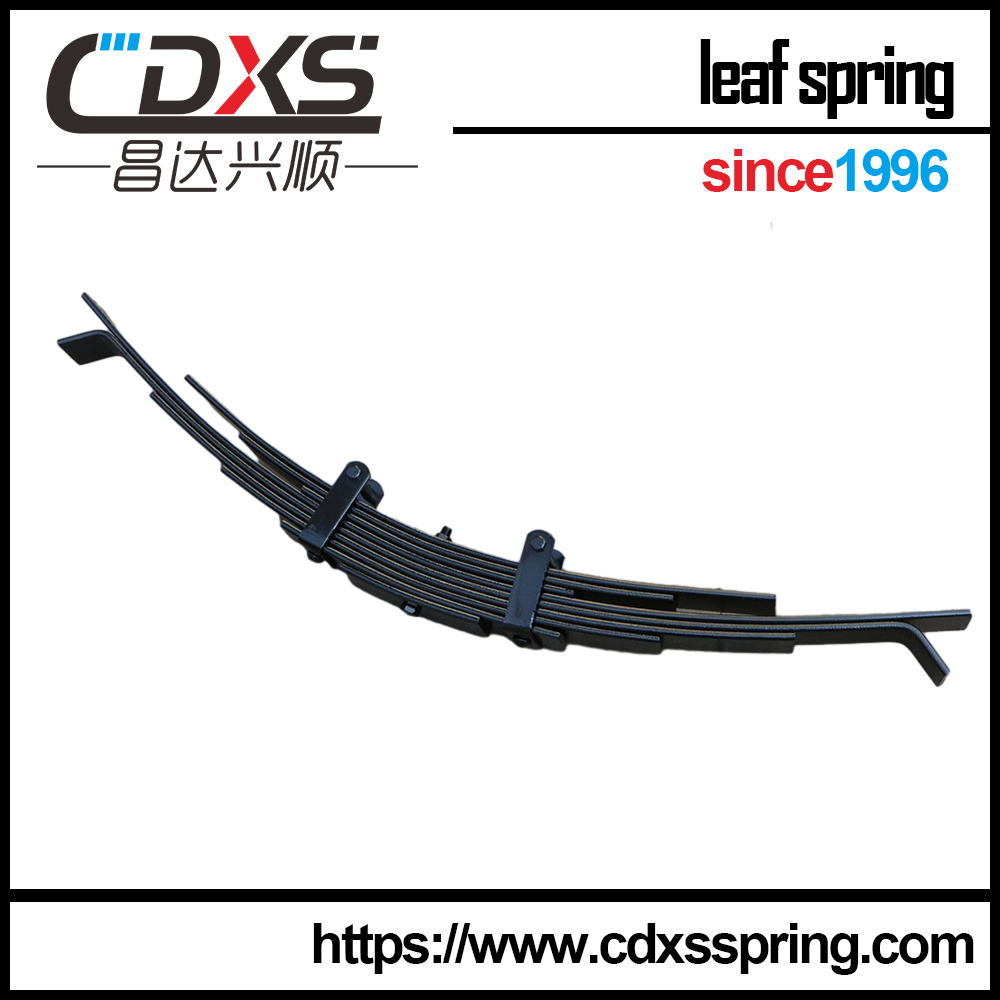
The causes and solutions of leaf spring breakage are as follows:
Cause of fracture
Installation issue
1.Loosening of the central bolt: This leads to concentrated force on the middle part of the leaf spring, making it prone to breakage.
Loosening of the U-bolt: It causes uneven force on the edge of the leaf spring, resulting in edge fracture.
Unreasonable addition of plates: The thickness or quantity of the leaf spring plates does not match, resulting in excessive force on a single plate.
Mixed use of new and old leaf springs: The elasticity difference between the two sides of the leaf springs is too large, and the new leaf spring is prone to breakage or the old leaf spring is flattened.
Usage environment and operation issues
2.Overloading and overweight: Exceeding the load-bearing limit of the leaf spring is a common cause of breakage.
Bumpy road impact: Frequent and severe vibrations cause fatigue damage to the leaf springs.
Long-term lack of maintenance: The leaf spring lifting lug bushing wears out and rusts, affecting its performance.
Materials and manufacturing issues
3.Material defects: The raw materials have segregation, inclusions, or improper heat treatment (such as overheating or overburning), which reduces the strength.
Fatigue fracture: Under long-term repeated force, the crack gradually expands to fracture.
Corrosion fatigue: Outdoor use or corrosive environments accelerate the aging of leaf springs.
Solution
Installation and Maintenance
1.Tighten the bolts: Regularly inspect and tighten the center bolts and U-bolts to prevent loosening.
Standard plate addition: Select matching leaf spring plates according to vehicle specifications to avoid excessive plate addition.
Regular maintenance: Check the wear condition of the leaf spring lifting lug bushing, and lubricate and replace it in a timely manner.
Usage management
2.Avoid overloading: Strictly abide by the vehicle’s load limit and rationally allocate goods.
Smooth driving: Slow down when passing through bumpy roads to reduce impact.
Choose road conditions: Try to avoid driving for long periods on bad road conditions, such as potholes and bumpy roads.
Materials and Quality control
3.Select qualified products: Purchase leaf springs with quality assurance and require suppliers to provide material certificates.
Check the appearance and performance: Before installation, inspect the leaf springs for any cracks or deformations and test whether the elasticity is uniform.
Dealing with corrosion issues: Regularly carry out anti-rust treatment on the leaf springs to prevent the corrosion from worsening.
If the leaf spring has broken, it should be replaced in time and the above-mentioned problems should be investigated to prevent it from breaking again.
So if you want to buy high-quality leaf springs, please contact me. +86 18837405116
Email:[email protected]