
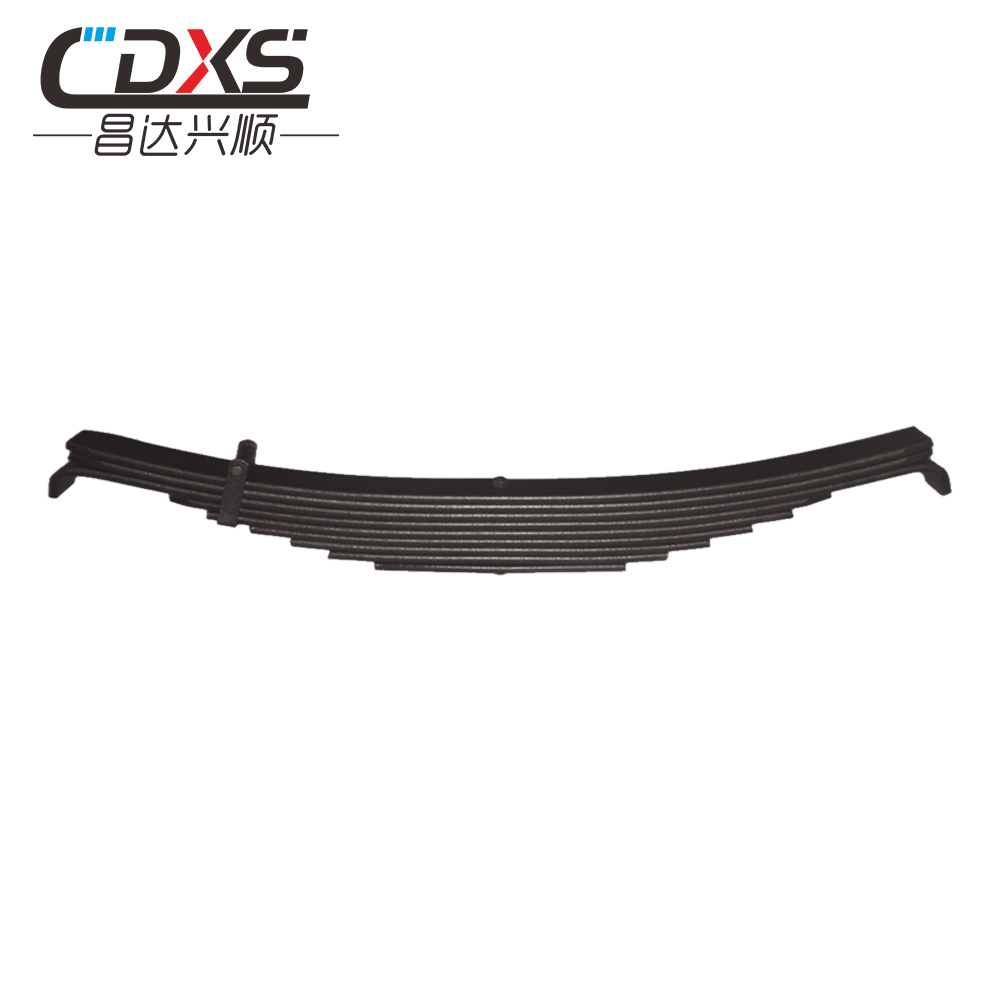
These terms refer to mechanical performance indicators involved in the design and raw material selection of automobile leaf springs. Their definitions and differences are as follows:
1. Stiffness
Definition: The ability of a material or structure to resist elastic deformation.
A higher stiffness means less deformation under the same external force.
It is related to Elastic Modulus (E). However, elastic modulus is a material property, while stiffness is a structural property (e.g., stiffness of a single leaf or the whole leaf spring assembly).
2. Strength
Definition: The ability of a material to resist permanent deformation or fracture.
• Tensile Strength: The maximum stress resisting tensile failure.
• Compressive Strength: The ability to resist compressive failure.
• Yield Strength: The critical stress at which a material begins plastic deformation.
3. Hardness
Definition: The ability of a material surface to resist local indentation or scratching.
Testing methods: Brinell Hardness (HB), Rockwell Hardness (HRC).
Relationship with strength: Materials with higher hardness generally have higher strength, yet there is no strict corresponding relationship.
4. Deflection
Definition: The elastic displacement of a structure under load (e.g., deflection of a single leaf or the whole leaf spring assembly).
Greater deflection indicates lower stiffness.
Its calculation formula depends on the structural type of the leaf spring.
5. Elasticity
Definition: The ability of a material to restore its original shape after external force is removed.
Elastic Limit: The maximum stress value at which a material maintains elasticity.
6. Toughness
Definition: The ability of a material to absorb energy during plastic deformation and fracture.
Difference from strength: High‑strength materials may be brittle with low toughness; materials with good toughness do not necessarily have high strength.
Testing method: Impact test (e.g., Charpy impact test).
7. Rigidity
Rigidity: A qualitative description emphasizing the overall characteristic that a material or structure is not prone to deformation.
Stiffness: A quantitative indicator of rigidity (unit: N/m).
8. Plasticity
Definition: The ability of a material to retain a new shape after deforming beyond its elastic limit.
Plasticity is opposite to brittleness; brittle materials have almost no plasticity.
Additional Key Differences
• Stiffness vs. Strength: High stiffness does not necessarily mean high strength.
• Hardness vs. Toughness: High‑hardness materials usually have poor toughness and are prone to fracture.
• Elasticity vs. Plasticity: Elastic deformation is reversible, while plastic deformation is irreversible.
Understanding these terms and their differences facilitates the design and raw material selection of leaf springs.