
I. Test Basis and Standards
GB/T19844-2018 “Leaf Springs”
2. Test product drawings or technical conditions.
Ii. Test Equipment
Leaf spring fatigue testing machine.
Iii. Operating Procedures
1. Clamping and supporting methods
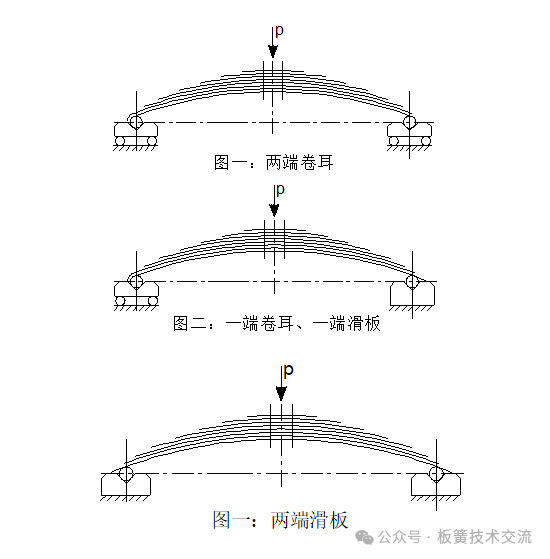
The clamping and support methods for the end with the lugs (or lifting lugs) are shown in Figure 1 or Figure 2 (the pulley is movable), and the clamping and support methods for the end without the lugs are shown in Figure 2 or Figure 3 (the pulley is fixed and does not move). The spacing (position) of the pulleys is determined by the working length of the product. The middle part shall be clamped in accordance with the requirements of the product drawing or the simulated loading conditions. (Our company uses general clamping plates and bolts to clamp the leaf springs, but there is a pad plate at the top and bottom between the general clamping plate and the leaf spring. The size and torque of the pad plate shall be consistent with the product drawing or the simulated loading state. When the size of the bolt is different, the torque shall be converted.)
2. Steps and methods of fatigue testing
(1) Before the test, a rigidity test should be conducted (the test steps and methods are detailed in “Test Methods for Rigidity of Automotive Leaf Springs”), and the measured static load arc height should be filled in the “Fatigue Test Record Form for Automotive Leaf Springs”.
(2) Clamp the leaf spring as required in Article 1, measure the no-load free arc height during clamping (at this time, weigh the arc height before rotation), and record it in the “Automobile Leaf Spring Fatigue Test Record Form”.
(3) In accordance with the requirements of Article 1, clamp and support the leaf spring on the testing machine’s worktable, apply a pre-load, and then conduct a pulsating fatigue test with a certain load amplitude. The calculation formulas for the deformation of the pre-applied load as Fmin and the amplitude of the pulsating load as Fa (with the maximum deformation being Fmax and the minimum deformation being Fmin) are as follows:
…
(4) Adjust the eccentricity of the testing machine according to the pulsation amplitude Fa value and tighten it, then “eccentric” it to the highest point. Adjust the lead screw stroke of the testing machine according to the pre-added deformation Fmin value and tighten it. First, start the motor and let it perform several reciprocating motions before shutting it down. Then, remove the pre-added deformation (i.e., return it to the “zero position”), measure the no-load free arc height during clamping (which can be done on the testing machine’s worktable) and record it (at this time, the arc height after weighing).
(5) Adjust the lead screw stroke of the testing machine again according to the pre-added deformation Fmin value and tighten it. Adjust the pulsation frequency as required by the product. Start the motor and let it work continuously.
When the test is conducted at 1×10⁴, 3×10⁴, 6×10⁴, and 9×10⁴ times, adjust the torque of the clamping bolts. And record the start-up and shutdown times in the “Bench Fatigue Test Record” table.
(7) During the test, observe the sample every 1×10⁴ times. After macroscopic cracks appear, observe it every 0.5×10⁴ times. The fatigue life of any steel plate is determined by the number of cycles at which a macroscopic crack first appears (breaking through along the thickness direction on both sides of the same part). And record the number of cycles, the sequence of broken plates, etc. in the “Automobile Leaf Spring Fatigue Test Record Form”.
(8) During the test, the leaf spring assembly should be cooled by a fan, and its temperature must not exceed 150℃.
(9) After the test is completed, promptly conduct hardness checks, metallographic analyses, etc. on the fractured pieces.
3. Conditions and life requirements for fatigue tests
According to Clause 4.6 of GB/T19844-2018 “Leaf Springs”, under the test conditions of a stress amplitude of 323.62Mpa (3300kgf/cm ²) and a maximum stress of 833.57Mpa (8500kgf/cm ²), the fatigue life of automotive leaf springs shall not be less than 80,000 times. The number of test termination cycles was 168,000 times (1.2 times that of the 140,000 times of the superior product).
(2) When the product drawings have specific fatigue test methods and fatigue life requirements, the requirements of the product drawings shall be followed.
Iv. Others
This regulation is applicable to the fatigue tests of multi-piece uniform cross-section leaf springs and fear-piece variable cross-section leaf springs. The composite variable stiffness leaf spring is suitable except for the adjustment of the pre-deformation amount and eccentricity as required by the product drawing in the second sub-item (3) of Article 3.
…
Professional leaf spring manufacturer: +86 18837405116